
Header
Legacies of Loss and Decolonial Care: Ethics, Enslavement, Identity
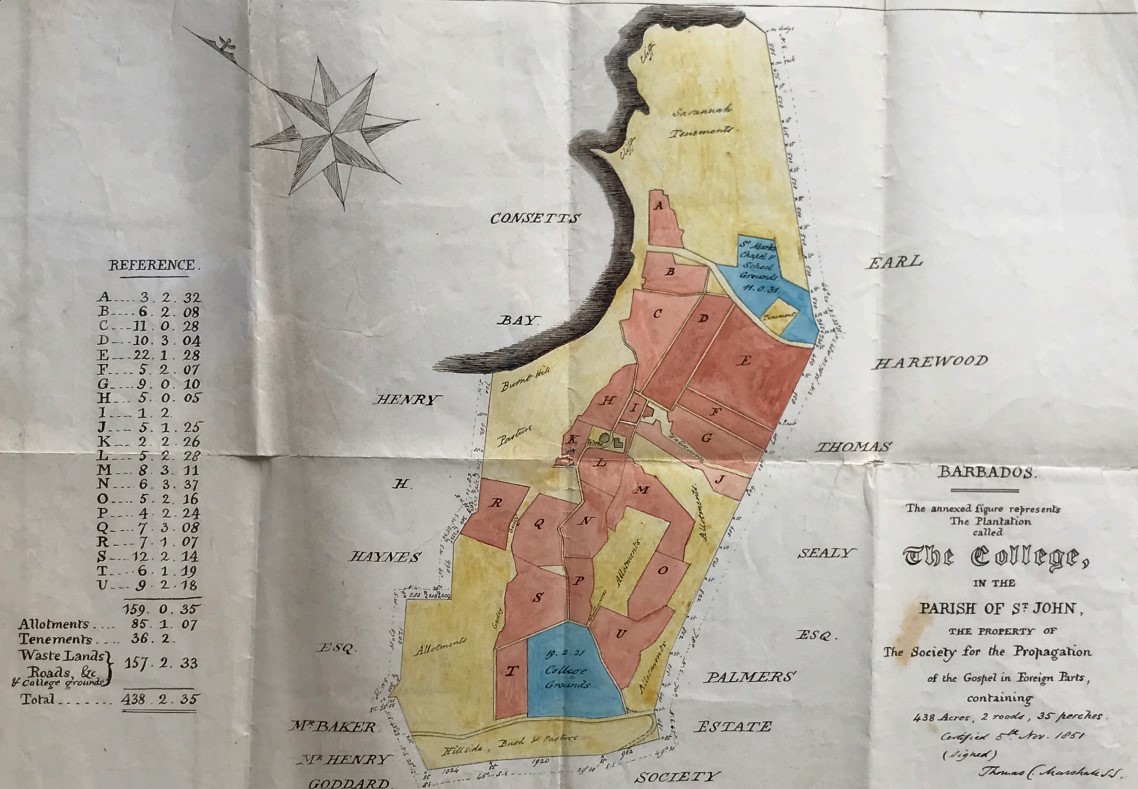
Map of the Codrington plantation, called ‘The College’ in the Parish of St. John’s, Barbados (5 November, 1851). T676 Codrington College (Various Trusts). USPG. Used under non-commercial licence.
Project overview
Creating and sustaining access to UK-based manuscript archives about transatlantic chattel slavery poses complex ethical questions for those working in metropolitan institutions: How is equitable access facilitated? How should care be extended when providing digital surrogates of archival materials detailing extreme violence? Whose stories are being told? By whom and for whom? This project builds on an existing collaboration between the School of English and USPG, an Anglican mission agency, which owned the Codrington plantations in Barbados. It resources USPG’s current reparative project with The Codrington Trust by gathering perspectives from archive/heritage/education specialists in the Caribbean and across the Afro-Caribbean diaspora to shape a programme designed to make archival materials available to descendant communities. The project facilitates conversations with these partners, also including Fulham Palace House and Garden, about legacies of loss, decolonial care, and reparative praxis when engaging histories of transatlantic enslavement.
Read a blog about the project by Postdoctoral Research Assistant Rev. Dr Garfield Campbell
Project team
- Professor Alison Searle, School of English, [email protected]
- Dr Jo Sadgrove, United Society Partners in the Gospel (USPG)
- Rev. Dr Garfield Campbell, Postdoctoral Research Assistant
- Sian Harrington, Fulham Palace House and Garden
- The Codrington Trust, Barbados.
What inspired you to develop this project?
There are very few ‘safe’ opportunities to explore the issues of positionality, privilege, and ethical accountability that continually re-emerge when working to provide access to digital surrogates of archival materials documenting historic harms in dialogue with descendant communities. Further ethical complexities surface when that research is communicated to a diverse set of audiences. Disseminating work around slavery and reparations in a context like the UK in which we, the Church of England, and USPG, are witnessing the co-option of Christianity by the far right in new forms of ‘Christian Nationalism’ has raised critical questions about whether and how we can facilitate public events in such polarised and potentially explosive environments. This project offers us the space intentionally to explore the complex ethical aspects of our engaged research with the diverse and trusted network of actors built in earlier stages of our collaborative work.
What are you hoping to achieve with your project?
This project enables us, in collaboration with key partners, to advance our work of making manuscripts and documents relating to the Codrington Estates held in archival collections in the UK available to descendant communities seeking to understand the ancestral histories of those who lived and worked on Barbados plantations. Stakeholder interviews will enhance our understanding of the debates around archives, descendant engagement, and community education projects in the Caribbean region to inform USPG’s ongoing reparative work alongside The Codrington Trust. Perhaps most importantly it will provide our team of researchers and collaborators, including Fulham Palace House and Garden, dedicated space and time to draw upon the wisdom of others working on similar kinds of projects so that we can reflect more deeply on the ethical issues entailed and develop a set of guidelines for best practice to inform our ongoing engaged research in Barbados, the UK, and beyond.
What are you most looking forward to in this project?
In increasingly polarised contexts, including the UK, it has become difficult to host public educational events relating to the entanglement of establishment institutions with slavery, racism, and empire due to the demands that managing hostility, impassioned contest, and ‘white fragility’ require. Individual behaviours within such environments can be harmful and disruptive to others present, undermining the safety of such spaces, and drawing attention to what a duty of care might require for convenors like us. This project provides the space and time to think intentionally about context, ethics, and praxis, including how best to communicate our engaged research and its implications given the currently fraught UK context. We are looking forward to co-creating a critical space within which we can share with and learn from the experiences and ethical quandaries of others working in and around heritage, archives, and reparations. The opportunity to question and challenge our own assumptions, and to resource others in the research network we have built over the last five years to do the same, is a gift.