
Let’s talk about ‘things’
Let's talk about 'things'
Project overview
Whether it's a football programme saved from a classic game, a recipe book stained with decades of use, or an old leather wallet, many of us hang on to certain items because of their emotional significance. But for people living with dementia, such objects can hold further power, reigniting long since forgotten memories, strengthening relationships, and reaffirming aspects of identity at times when so much else in life feels uncertain.
It is this power of the everyday that sits at the heart of ‘Let’s Talk About “Things”: Celebrating Evocative Objects for People with Dementia’, a project led by Dr Catherine Stones, Associate Professor of Graphic Design at the University of Leeds’ School of Design. The project – which was supported by the University’s Impact Acceleration Account (IAA) – aimed to make the value of personal objects more visible and actionable within dementia care.
Working with Dr Jeanne Louise-Moys (School of Design) and Yorkshire-based mental health charity Inspire North, Dr Stones collaborated with four creatives and 15 participants from three dementia hubs across West Yorkshire. Together, they co-produced an exhibition of 19 artworks, including visual pieces and poetry, inspired by objects chosen by participants living with early-stage dementia.

'Ian’s Take Offs', Ian and Catherine, Digital Illustration
“We wanted to explore the value and potential of storytelling and co-creation of arts methodologies with people living with early-stage dementia,” says Dr Stones, “which simply wouldn't have been possible without this funding."
Displayed in multiple formats to allow simultaneous showings, the work has been exhibited at a range of venues, including Leeds Central Library, the Leeds Young Dementia Hub, the Khidmat Centre in Bradford, an Age UK shop in Halifax city centre, Hebden Bridge Picture House – where it reached audiences attending dementia-friendly screenings – and Inspire North’s offices in Bradford. Further exhibitions are planned, including an event aimed specifically at engaging dementia professionals. The exhibition is also available online, extending its reach beyond the region and enabling wider engagement with the stories behind the objects.
Alongside the exhibition, the team co-developed the ‘Talking About Things’ toolkit. Designed in close consultation with participants and stakeholders, the spiral-bound booklet was carefully crafted to be dementia-friendly and accessible, including translated versions in Urdu and Punjabi. In total, 300 printed copies were produced and distributed through Inspire North’s dementia hubs, with free downloadable versions available online to ensure wider access.
Initial anecdotal feedback suggests the toolkit resonates not only with those currently navigating a diagnosis but also with families reflecting on past experiences. One visitor to the Leeds exhibition commented that they wished they had used such a resource when their own mother had first been diagnosed. Another said the project prompted them to go home and “put things on paper” themselves.
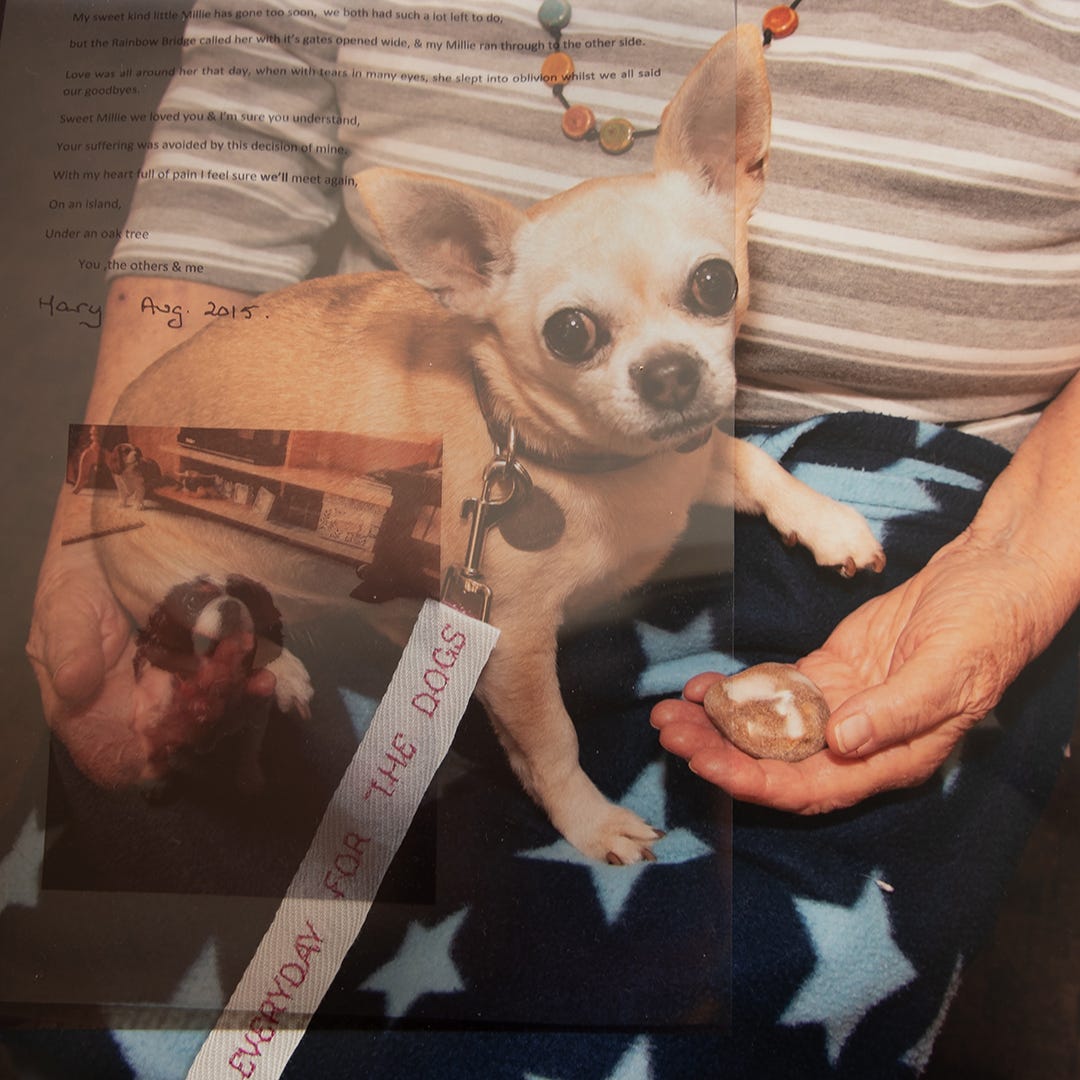
'Stone, Poem, Dog — A Portrait in Fragments', Lucy and Emma, Mixed Media/Digital Print
Meanwhile, the project has generated valuable insights for professionals. Through evaluation work linked to a previous iteration of the project in Belgium, participants reported that their stories continued to be shared long after the workshops ended, and some care professionals described paying greater attention to the objects in their everyday practice. In West Yorkshire, new connections have been forged with support workers and with members of the South Asian community, where stigma surrounding dementia can still present barriers to engagement.
Inspire North have already committed to further exhibitions and are exploring how the toolkit might be tested and expanded in a new North Yorkshire hub. Dr Stones and her collaborators are also preparing an Arts and Humanities Research Council bid to extend their arts-based methodology, particularly in relation to dementia and South Asian communities.
Project team
Dr Catherine Stones (School of Design)
Dr Jeanne Louise-Moys (School of Design)
Community Links, Leeds
