
Reducing Inequalities Through Education: RITE Launches at the University of Leeds
On 2nd June, colleagues from across the University of Leeds gathered for the launch of RITE: Reducing Inequalities Through Education. RITE is a new cross-Faculty research network supported by LAHRI, committed to improving children and young people's life chances through data-driven, community-grounded research.
The room reflected the network's interdisciplinary ambitions. Academic colleagues came from Schools of Education, Psychology, Languages Cultures & Societies, and the Leeds Institute for Societal Futures, alongside Professional Services colleagues including from the Research and Innovation Service, Advancement Team, Horizons Institute, and the Lifelong Learning Centre. Over 38 colleagues registered, highlighting the local appetite for our collaborative work to reduce inequality.
What RITE is and why it matters
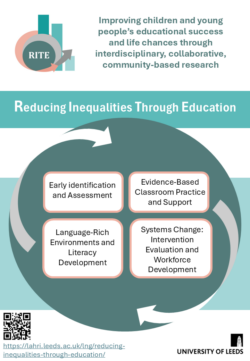
In her opening address, Cat Davies outlined RITE's mission: to tackle entrenched and widening educational attainment gaps through interdisciplinary, co-produced, openly shared research, spanning early years through to further and higher education.
The network is built around four active research themes: Early Identification and Assessment; Language-Rich Environments and Literacy Development; Evidence-Based Classroom Practice and Support; and Systems Change: Intervention Evaluation and Workforce Development. RITE is also running an innovative metaresearch study, evaluating our collaborative model using reflective practice to develop a theory of change.
Research in action: the lightning talks
Eight short talks brought the themes to life. On early identification, Hannah Nash presented dynamic assessment as an inclusive approach to identifying dyslexia, and Cecile De Cat showcased Q-BEx as a first-level triage tool for supporting developmental language concerns in multilingual communities. On language-rich environments, PhD researcher Katy Grainger shared the community-based Reception Book Buddies intervention, co-produced with Leeds Libraries, while Anna Harwood presented a combined reading comprehension and wellbeing programme for struggling readers. Amanda Waterman and Paula Clarke addressed classroom practice — working memory support and play-based learning respectively. Finally, Erin Dysart reported on Concept Cat (with Louise Tracey) - the efficacy trial of an early conceptual vocabulary intervention to reduce the disadvantage gap, with benefits for early numeracy and parental engagement, and Aimee Code described a pilot project supporting childminders to create communication-friendly home-based settings.
Discussion and next steps
The second hour moved into small group discussions on four priorities. On internal collaboration, colleagues identified the need for better researcher profile visibility and flagged a particular opportunity for RITE to convene expertise around the educational implications of long-term health conditions. On external collaboration, web presence and clearer articulation of the benefits of partnership were highlighted. The engaged research group emphasised relationship-building with families and communities as essential groundwork, and noted the vital role of smaller internal funding schemes in making participatory research possible. The funding group identified Marie Curie Fellowships and Doctoral Networks as strategic targets.
RITE is growing. If you'd like to get involved or find out more, go to our website at https://lahri.leeds.ac.uk/lng/reducing-inequalities-through-education/ or get in touch at [email protected]