
R-JCH Roundtable
On 15 July 2026, the Rethinking Jewish Cultural Heritage (R-JCH) team organised a roundtable at the British and Irish Association for Jewish Studies (BIAJS) Annual Conference, held at Birkbeck, University of London. Responding to the conference theme, ‘Space and Place’, the roundtable, Jewish Heritage Now: Politics, Visibility, Agency, explored the growing prominence of Jewish heritage in contemporary public and academic discourse.
The discussion addressed a series of pressing questions: Why, and where, has Jewish heritage become increasingly visible in recent years? What are the benefits and risks of this visibility? How should scholars, heritage professionals, and community stakeholders navigate the political entanglements of Jewish heritage in an era of increasing polarisation, both within Jewish communities and beyond? Participants also considered the relationship between Jewish heritage and tradition, the role of heritage activism, emerging approaches to Holocaust memory and commemorative politics, and the challenge of balancing preservation with innovation in heritage research, display, and public engagement. Particular attention was paid to opportunities for dialogue and collaboration with other diasporic and minoritised communities, as well as to contemporary debates around solidarity, decolonisation, dissent, diversity, and inclusion.
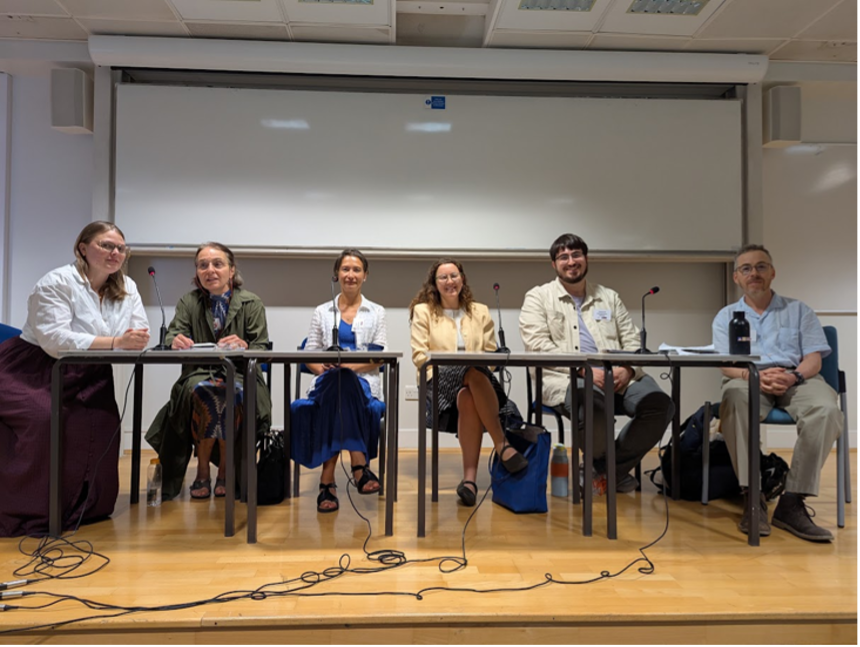
Participants in the R-JCH roundtable
Left to right: Dr Anne Caldwell, Dr Eva Frojmovic, Professor Yulia Egorova, Dr Anoushka Alexander-Rose, Dr Samuel Goldstone-Brady, Professor Jay Prosser.
The roundtable was proposed and facilitated by Dr Eva Frojmovic, Director of the Centre for Jewish Studies. Speakers included Dr Anne Caldwell and Professor Jay Prosser from the R-JCH team and the Centre for Jewish Studies, alongside project partners and collaborators Dr Anoushka Alexander-Rose (University of Heidelberg), Professor Yulia Egorova (Durham University), and Dr Samuel Goldstone-Brady, Curator of the Manchester Jewish Museum.
Several key themes emerged from the discussion. Participants emphasised the importance of recognising Jewish heritage as inherently plural, encouraging a shift from thinking about a single Jewish heritage to multiple Jewish heritages. The conversation also highlighted the need to move beyond viewing heritage as a preserved ‘terrarium’ and instead to understand it as a living ‘habitat’, building on ideas developed by Professor Sarah Ross during the course of the project. The value of decolonial theory and critical heritage studies was repeatedly underscored, alongside the growing significance of digital heritage. Speakers also stressed the importance of recognising communities as active agents and co-producers in heritage work, rather than simply as audiences or beneficiaries.
Next Steps
Building on these discussions, members of the R-JCH team are developing new work on Jewish cultural heritage and the decolonisation of Jewish studies as key strands of activity for the coming year. The team is currently preparing a number of funding applications and collaborative projects that will further explore these themes and strengthen partnerships across the heritage, cultural, and academic sectors.
Guidelines for Ways of Representing Jewish Heritage in the UK developed by Alexander-Rose and Egorova are being launched at an event at Manchester Jewish Museum.