
LAHRI Spotlight on Alix Brodie-Wray, Faculty Impact Development Manager
In this post we focus on a colleague, letting you get to know more about them and their role. In the spotlight in this edition is Faculty Impact Development Manager, Alix Brodie-Wray.
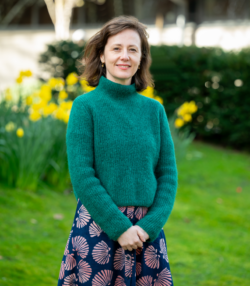
Hi Alix, can you explain what your job entails?
My job entails working with academic and professional support staff to develop understandings of the impact our work has (or could have) in the world beyond academia. Impact as a term has a few uses in the world of higher education – in my job it applies to impact as a demonstrable change directly (if sometimes circuitously) caused by research outcomes, findings, and processes.
Impact has been part of the Research Excellence Framework since its introduction as a component in REF2014 and is now expected as an embedded part of some core research fundings schemes we rely on in the HE research world. So being able to articulate impact has tangible benefits in terms of income, but also has more important value through its own realisation: it also helps us remain relevant in a world which has been increasingly circumspect about the value of academic work.
If there was one thing you wished people knew about impact, what would it be?
Impact is change. Once you see that, you start to see it in your own work and not something unreachably complex. It also cuts away the potential application of impact as a cynical act – impact as change reminds not to do it unless it’s going to change something, for real.
What is coming up in the Impact world in the next 12 months?
As REF was a big catalyst for uptake in the ‘impact agenda’ – we’ll be looking out for further news on changes to REF. REF are changing part of the submission to include a ‘People, Culture and Environment’ element which they are piloting very soon: it will be interesting to see if that allows us to be more inclusive in our submissions.
We also have closer to home our first ever Arts and Humanities Impact Accelerator Account – this is an internal fundings scheme filling a previous gap in our ‘translational research’ funding portfolio. It’s not particularly focussed on REF so I’m looking forward to seeing what comes in from our research community!
What advice would you give to someone starting out in a role like yours?
Don’t worry if you are working with academics outside of your area or if you aren’t from an academic background: your perspective is very valuable. It not only helps academics to articulate their work to non-experts, you are able to see possibilities at a somewhat removed vantage that are hard to spot at the ‘coal face’ of the work itself.
What are your favourite things about working at Leeds?
First – the people: interesting, approachable and interested in so many things.
Then the campus – nothing like seeing a heron or a family of rabbits on the way into work to make you feel at a comfortable proximity to nature!
You run the AHC Faculty Craft Club. Can you tell us more about it?
Yes! This started as a knitting club in the School of Design – a way for staff and students to get to know each other outside of the usual circles. I moved roles to Music and PCI and kept it on as a Faculty wide thing. We have a lovely group of people: PGRs, technicians, academics – but the hard-core group are the PGRs and technicians in Design (shout out to Alice, Ioana and Mary) who are stalwarts (as well as deeply talented people). My new job has meant I can’t make it as much at the moment, but when I do I feel so much better: making things is really good for the soul.